
"Phoenix Rising" Ranked No. 4 in textura’s Top 20 Classical Recordings
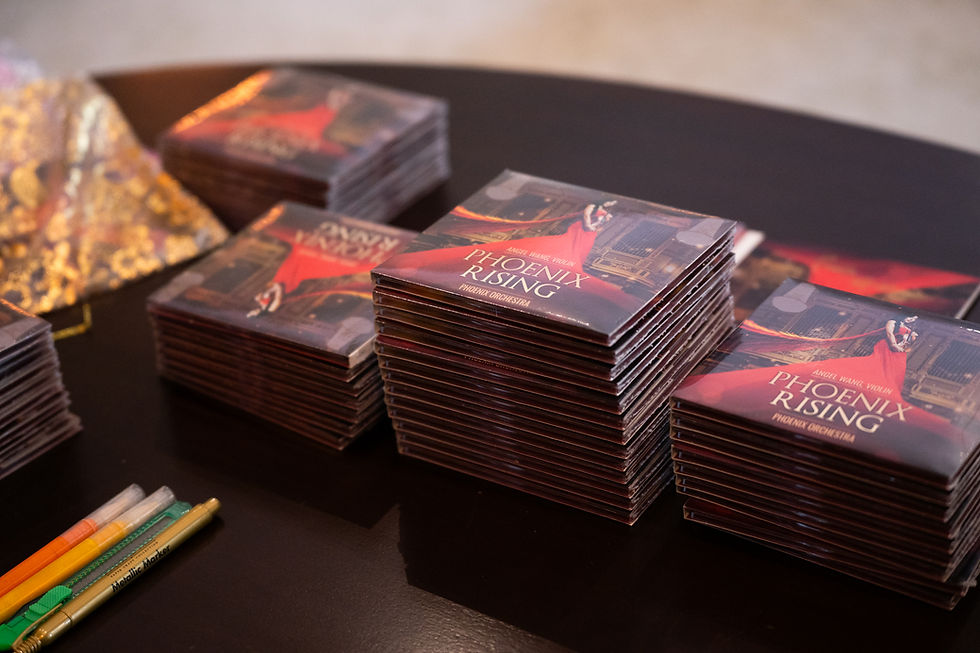
Angel Wang & Phoenix Orchestra’s Phoenix Rising has been ranked No. 4 in textura’s “Top 20 Classical” list in the Instrumental: Quartet / Ensemble / Orchestra category.
Published in November 2025, the review places Phoenix Rising among the year’s notable classical recordings and highlights the album’s distinctive dialogue between Chinese musical traditions and Western classical music.
Rather than treating the repertoire as a simple collection of Chinese-inspired works, textura emphasizes the album’s carefully constructed musical architecture. The reviewer describes the recording as:
“a splendid convergence of Chinese and Western classical material.”
This convergence is at the heart of Phoenix Rising. The album brings together the beloved Butterfly Lovers’ Concerto, traditional Chinese songs, and the newly commissioned contemporary work Phoenix Rising by Canadian composer Alice Ping Yee Ho.

A Musical Dialogue Between East and West
One of the most distinctive aspects of textura’s review is its recognition of the album’s symmetrical structure.
The program begins with He Zhanhao and Chen Gang’s Butterfly Lovers’ Concerto, moves through a selection of traditional Chinese and Mongolian-inspired repertoire, and concludes with Alice Ping Yee Ho’s contemporary Phoenix Rising.
According to the review, Ho’s work provides a particularly effective conclusion because it represents:
“a seamless blend of old and new”
This structural idea gives the album a clear artistic direction. Traditional melodies are not presented simply as historical artifacts; instead, they become part of a broader musical conversation that leads naturally toward contemporary composition.
Angel Wang and Phoenix Orchestra: A Natural Musical Partnership
Textura also draws attention to the close musical relationship between soloist Angel Wang and Phoenix Orchestra.

The reviewer notes that if the performances sound particularly well integrated, there is a simple explanation: Angel Wang is not only the featured violinist, but also the founder and Artistic Director of Phoenix Orchestra.
The review describes their playing as:
“symbiotic”
This sense of unity is especially evident in the Butterfly Lovers’ Concerto, where Wang’s violin moves through contrasting musical moods while remaining closely connected to the orchestra.
Textura praises Wang’s performance throughout the concerto, describing it as a:
“towering performance”
and noting that it remains impressive across the work’s changing emotional landscapes.
A Powerful Interpretation of The Butterfly Lovers’ Concerto
Textura considers the 1959 Butterfly Lovers’ Concerto a modern Chinese masterpiece and highlights its significance as a work that combines Chinese and Western compositional techniques.
The concerto’s seven contrasting sections move from fragile and poignant passages to energetic and dramatic episodes. In the reviewer’s description, the opening creates an almost pastoral atmosphere before the solo violin enters with its expressive melody.

Wang’s playing is singled out for particular praise. The review observes her command of the upper register and her ability to move convincingly between lyrical passages and the work’s more energetic dance sections.
The reviewer ultimately concludes that only one listening is enough to understand:
“why the work has become such a crowd-pleaser.”
Traditional Songs Full of Character
Following the concerto, five traditional pieces create what textura describes as a smooth transition toward Alice Ping Yee Ho’s contemporary composition.
The reviewer highlights several individual works.
Song of Four Seasons is described as radiating an:
“endlessly affable glow”

while Liu Tieshan and Mao Yuan’s Dance of the Yao People is praised for its vivid combination of haunting themes and energetic dance gestures.
In Mayila, Wang’s violin is used almost as a human voice, embodying the story of a young girl whose beautiful singing captivates everyone who hears her.
Galloping Horses takes a completely different direction. Full of energy, the piece evokes horses racing across the vast Mongolian grasslands, with the reviewer once again praising Wang’s dazzling and high-energy playing.
The sequence concludes with Jasmine Flower, described by textura as a serene eighteenth-century folk song from the Qing dynasty. The review also notes its wider cultural significance, including its use as the Chinese Princess’s leitmotif in Puccini’s Turandot.

Phoenix Rising: A New Chapter in the Album’s Story
The album’s title work, Phoenix Rising, was commissioned specifically for Angel Wang by Canadian composer Alice Ping Yee Ho.
The approximately eleven-minute, single-movement tone poem received its world premiere at Toronto’s Koerner Hall in December 2023 before being recorded for the album.
For textura, the piece is more than simply the final track. It brings together the central ideas of the entire album.
The reviewer describes it as:
“a seamless blend of old and new and thus emblematic of the album in general.”
The work begins with the violin emerging above an atmospheric orchestral texture. As the music gradually develops, the reviewer hears suggestions of hope and rebirth—ideas closely connected to the symbolic meaning of the phoenix.
Textura describes the orchestral writing as:
“painterly in its expansive palette of hues and textural shadings.”
The composition develops along an unpredictable but consistently engaging path, combining mystery, atmosphere, and expressive color before reaching its conclusion.
The reviewer ultimately regards the work as an important addition to Wang’s repertoire, describing it as:
“a terrific standalone setting”
that could enhance future concerts by Angel Wang and Phoenix Orchestra.
A Promising Future
Textura’s review ends by looking beyond the album itself. The successful combination of traditional and contemporary repertoire creates anticipation for what Angel Wang and Phoenix Orchestra might explore next.
The reviewer writes that their:
“merging of old and new material engenders excitement for what Wang and company might craft for a follow-up.”
For Phoenix Rising, this may be one of the most meaningful observations of all. The album is not presented merely as a recording of existing repertoire. It is seen as the beginning of an artistic direction—one that brings Chinese musical traditions, Western classical techniques, traditional repertoire, and contemporary composition into the same musical space.
Being ranked No. 4 in textura’s Top 20 Classical — Instrumental: Quartet / Ensemble / Orchestra is a significant recognition of that artistic vision.
For Angel Wang, Claudio Vena, Phoenix Orchestra, and composer Alice Ping Yee Ho, Phoenix Rising demonstrates how music can connect different cultures and generations—not by erasing their differences, but by allowing them to speak to one another.
The journey of Phoenix Rising continues.
Article reviews:


Comments